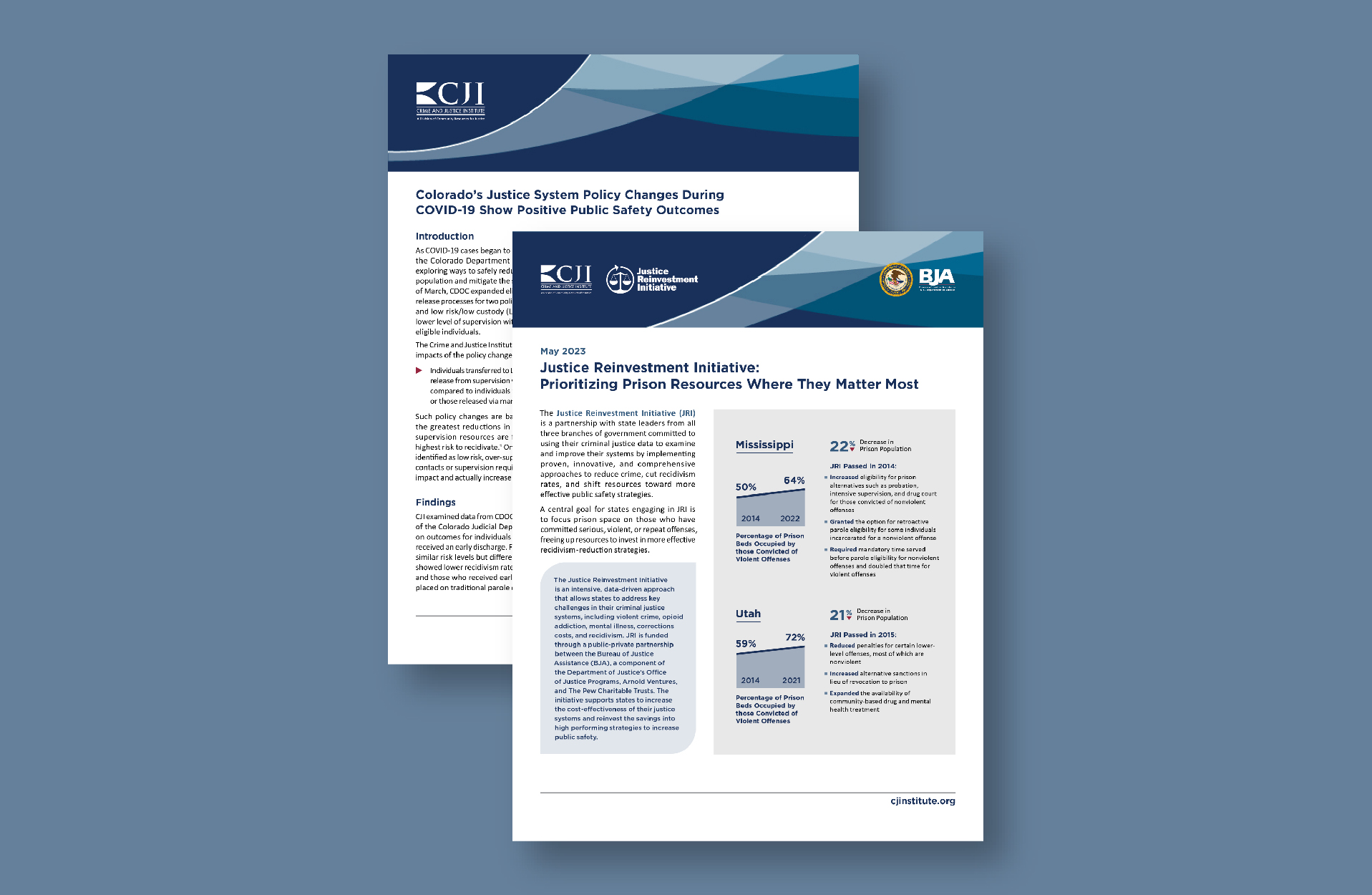


For more than a decade, the Crime and Justice Institute (CJI) partnered with states through the Justice Reinvestment Initiative (JRI) to advance data-driven criminal justice reforms that strengthen public safety by reducing recidivism, improving rehabilitation outcomes, and promoting the effective use of criminal justice resources. Working closely with governors’ offices, state legislatures, justice system leaders, and community stakeholders, CJI has supported states interested in using a data-driven approach to design, enact, and implement system-level reforms.
Throughout our time with JRI, we worked with more than a dozen states and numerous counties, many in partnership with the Bureau of Justice Assistance (BJA) at the Department of Justice, The Pew Charitable Trusts, and Pew’s Public Safety Performance Project (PPSP). In these partnerships, CJI helped states translate the analysis and recommendations generated through JRI into fiscally responsible, data-driven policies and practices in sentencing and corrections that protect public safety, hold individuals accountable, and manage corrections costs.
CJI has played a significant role in the adoption of comprehensive adult justice reforms in states including Tennessee, Nevada, Georgia, South Dakota, Utah, South Carolina, Mississippi, and Alaska—many of which involved substantial changes to criminal sentencing policy. Following the passage of legislation, CJI provided multiple years of implementation technical assistance to ensure that reforms result in sustained, on-the-ground change. Most recent implementation sites include Mississippi, Utah, Alaska, and Maryland.
Examples of successful JRI efforts include:
- Nevada: In 2018, Nevada’s prison population had increased 7 percent over the previous decade and was projected to climb another 9 percent by 2028, costing taxpayers an additional $770 million. In 2019, the state passed JRI legislation designed to reduce recidivism, slow prison population growth, and invest in behavioral health services in the community. The bill is projected to avert 63 percent of the estimated prison population growth over the next 10 years, saving taxpayers $543 million. CJI is currently assisting Nevada with Phase II implementation.
- Utah: In the decade leading up to its pursuing JRI in 2015, Utah’s prison population grew 18 percent and was on track to increase another 37 percent in the next 20 years at a cost of $500 million. Utah leaders responded by passing JRI legislation that prioritized expensive prison space for serious and violent offenders, strengthened probation and parole systems, and expanded offender reentry and treatment programs. As a result, Utah’s prison population fell 12 percent in just two years, with a 40 percent reduction in imprisonment for nonviolent offenses. At the same time, successful probation completion increased 20 percent, improving public safety.
- South Carolina: South Carolina’s correctional population tripled from 1985 to 2010 and was projected to grow another 13 percent by 2014. State leaders responded by passing JRI legislation that improved community supervision, prioritized prison space for more serious and violent offenders, and created mechanisms to monitor the reforms going forward. The state’s prison population has since declined 14 percent, averting almost $500 million in costs, and the crime rate has continued to decrease.
Click here to read an overview of the JRI process, goals, and outcomes.
Justice Reinvestment Initiative Assessment Center
In December 2023, the BJA announced the launch of the Justice Reinvestment Initiative Assessment Center, or JAC, to provide states with a multitude of opportunities to engage with data and research to better understand and address their most pressing criminal justice challenges.
As part of the JAC, the CJI and The Council of State Governments (CSG) Justice Center offered states different types of technical assistance, including the following:
- In-state meetings and assessment from CJI or the CSG Justice Center to explore the viability of a JRI engagement in your state
- Targeted, short-term technical assistance to identify and better understand specific challenges or assist areas for improvement
- Tailored presentations or briefings before key state entities (such as executive branch bodies, legislative committees, statewide associations, statewide task forces, or working groups) to discuss your state’s criminal justice challenges and effective criminal justice practices
- Participation in convenings and events (facilitation, speaking on panels, etc.) to bring together system stakeholders and discuss a specific issue or generate interest in justice system improvements
- Additional research and information on state and local policy and practice challenges and changes covered during the summit
For more information about past justice reinvestment initiatives, or to explore policy support available to your state today, please contact:
Leonard W. Engel, Esq.
Director of Policy and Campaigns
A division of Community Resources for Justice
lengel@cjinstitute.org